


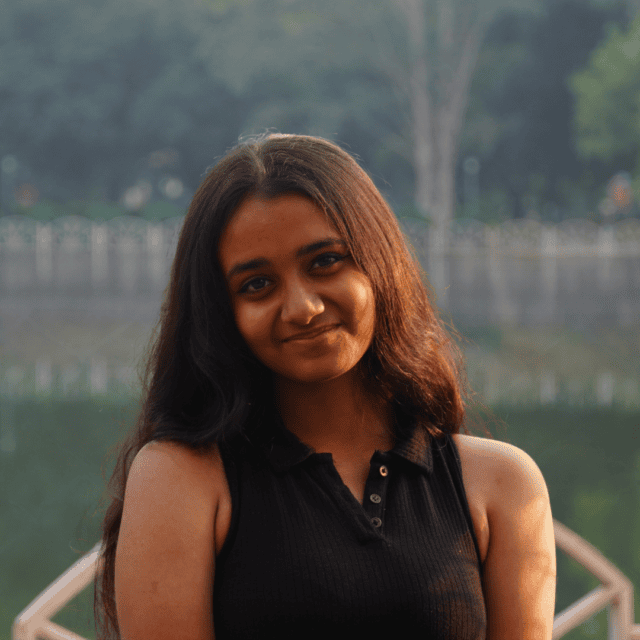
Biography: Pratyasha Nath is a visual artist and urban researcher working at the intersection of political ecology, multispecies studies, and comics practice. She completed her Bachelor and Master degrees in Biotechnology and Biochemical Engineering from the Indian Institute of Technology Kharagpur in 2025, with a thesis based in the Immunology and Inflammation Research Laboratory. Ever since receiving a FAST India Science Book Fellowship Grantee for 2024-25, she has been working on a comic book project about less visible multispecies actors. She is also active as a public speaker and workshop facilitator, and her visual work has been exhibited internationally. At present, she is a doctoral student at Technische Universität Berlin.
PhD Thesis Working Title: Fables for the Anthropocene: Microbial Entanglements and Wicked Urban Problems
Abstract: An increasing percentage of the world’s population is living in urban areas. Urbanisation today is distinct from urbanisation in the past in matters of scale, rate, and shifting geography (Mukherjee, 2016). The emergence of the ‘peri-urban’ is one of the crucial aspects of contemporary urbanization processes. The effects of human existence seep beyond the boundaries of the urban and manifest in the uneasy and unruly peri-urban. Understanding these effects requires a critical discussion of the existing Anthropocene discourse. The dominant strands of scholarship focus either on technology-driven management and ‘taming’ of natural ‘resources’ or on knowledge-driven healing of a wounded Earth system. There is a third emerging strand grounded in Environmental Humanities that deserves greater visibility within academia as well as out of it: more-than-human perspectives. As a human researcher, it is never truly possible to see the world from the point of view of a different species, but the more-than-human discourse helps to bridge the rift created between humans and other natural entities. The complex communities of bacteria, fungi, algae, and other microorganisms inhabiting cities remain largely invisible in urban planning, policy, and public imagination. This invisibility becomes problematic when addressing complex, interconnected crises like antimicrobial resistance (AMR), ecological degradation, or water pollution. Rittel & Webber (1973) describe these problems as “wicked” because their various entanglements prevent them from being adequately understood by siloed disciplinary approaches or from being managed by top-down technical solutions. In this research, the (peri)urban (the peri-urban is understood to be intrinsically connected to the urban and inseparable from it) is framed as a living systems infrastructure, and focus is placed on the microbial inhabitant-actors of the environment who hide in plain sight. Through co-created fables developed using participatory action research and art-based methods, the microorganisms of the East Kolkata Wetlands become the protagonists of new-age fables that inspire hope for a desirable Anthropocene by helping readers become-with (Haraway, 2016) the microbes. What even is a desirable Anthropocene? It is well accepted that cities represent the future of global living. This future is only worth looking forward to if we turn our animosities with the microbial world into mutually beneficial alliances. The ecotonal nature of the site creates the possibility for employing a similar assemblage of uncommon disciplines to make sense of microbial entanglements in the context of wicked urban problems (WUPs). Narrative interviews, key informant interviews (KIIs), and participatory workshops ensure that the process of knowledge creation is dialogic and not dialectic.