


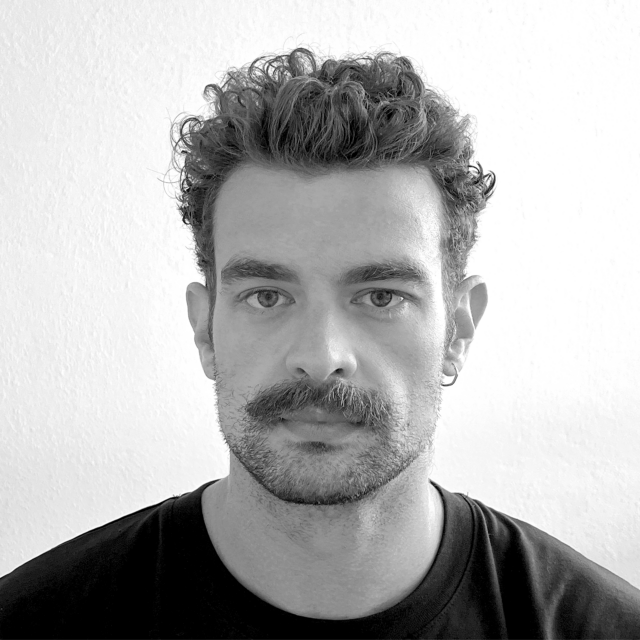
Biography: Gianluca Perseu is a Brazilian architect, urbanist, researcher, and currently a Doctoral Fellow at the Institute of Urban and Regional Planning of Technische Universität Berlin. Encompassing research, teaching, urban pedagogy, and design practice, his work lies at the intersection of landscape theory, digital technologies, and an attentiveness to contemporary modes of existence within informational capitalism.
He holds a Master’s degree in Urban and Regional Planning (PROPUR/UFRGS), with a dissertation nominated for the National Association of Urban and Regional Planning Researchers (ANPUR) Award. He has completed postgraduate specialisations in Project and Construction Management and Valuation and Expert Engineering, and has taught a range of undergraduate and postgraduate courses in Architecture and Urbanism at institutions including the Federal University of Rio Grande do Sul and La Salle University.
He has participated in research groups across multiple fields of knowledge and currently coordinates the R.U.A. and Cartografia da Hospitalidade collectives. Through these groups, he has facilitated urban interventions, workshops, and discussions as part of initiatives such as Jane’s Walk Porto Alegre, the UN-Habitat Urban Circuit, and various academic events.
PhD Thesis Working Title: Atlas of Landscape Desire: mapping global landscapes through waterfront development digital narratives in the Global South and North.
Abstract: Urban waterfronts around the planet have been consolidated, in recent decades, as prime locations of international capital interest. Widely targeted by strategic planning practices, they both express and enact the insertion of cityscapes into a global market of images and into an informational economy of desire. Marketed as offering unique experiences and architectural distinction, such projects often reproduce similar aesthetics and functional models, frequently emulating urban images from the Global North or other global cities deemed superior, at the expense of local specificity, social needs, and environmental commitments. The production of spectacular landscapes is thus entangled with that of precariousness, particularly in the Global South, where concentrated attention to these sites often coincides with the neglect of peripheral and marginalized communities and territories. The production of landscapes under neoliberal power thus emerges as a wicked urban problem: one that resists closure and demands continuous, critical engagement. Exploring this condition enables a deeper understanding of the contradictions shaping contemporary urbanization and supports the pursuit of more inclusive, resilient, and sustainable cities, in line with the aspirations of the UN Sustainable Development Goal 11. A systematic literature review indicates that waterfront development has been a recurring typology for strategic planning and urban regeneration since the 1960s, as well as a much debated topic in urban studies. However, much of this scholarship remains oriented toward material and morphological analysis, or toward descriptive and quantitative assessments of collective perception. The present study aims to map the production of contemporary landscapes by collecting, archiving, and interpreting online narratives that reflect the collective experience of space during the implementation of waterfront development projects in global cities of the Global South and North. It approaches: (i) landscape as a category for apprehending space and a sociocultural phenomenon rooted in both formal and experiential dimensions of urban life; (ii) information and communication technologies as mediators of sensory experience and instruments of neoliberal governance; and (iii) narrative as a methodological and political tool for investigating urban experience. Using a case study strategy, a set of urban waterfront development projects will be examined, selected to reflect Global South–Global North dynamics. Data will be drawn from multiple sources, with a primary focus on Instagram posts. Posts will be collected, sampled, and interpreted to identify how subjectivity participates in the production and reception of these landscapes. By developing a replicable framework for collecting and interpreting contemporary landscapes through digital narratives, this research positions itself as a counterpoint to the dominance of descriptive data analysis, foregrounding the role of collective experience in shaping more attentive and plural urban futures.