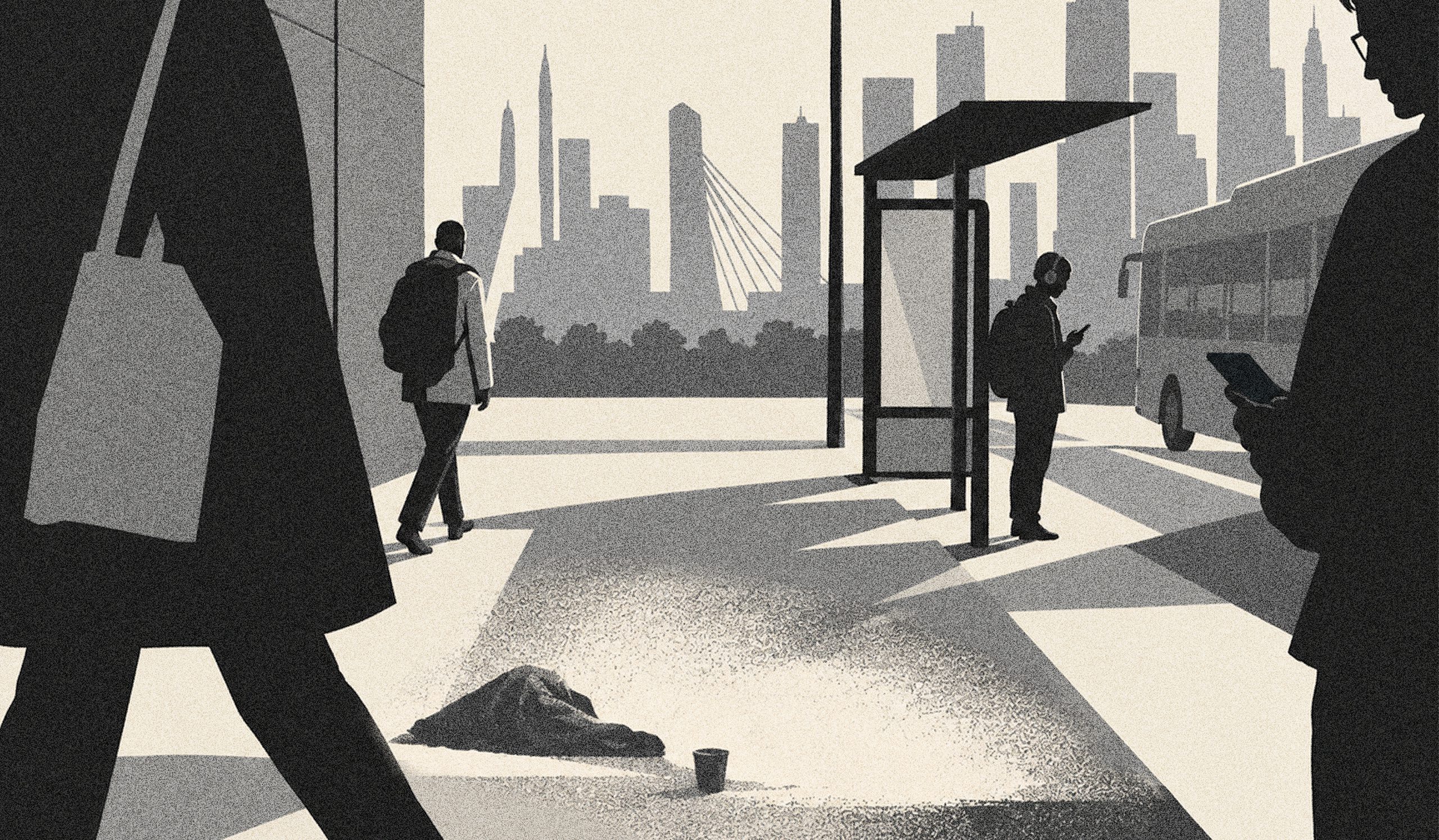
Homeless people formed one of the most vulnerable social groups to the impacts of the Covid-19 pandemic. Although they occupied a social position marked by food insecurity, lack of shelter for isolation and impossibility of adhering to adequate health care, there was no systematic record of their death cases, a fundamental action to measure the impact of health crises on the streets and the risks to which this population is exposed every day.
This research aims to explains the social silence around these deaths in São Paulo between 2020 and 2022. It shows that this oblivion may be related to the mismatch between the ways in which public managers, activists, journalists, frontline workers and the homeless themselves perceive the moments when there is a risk of death on the streets. In what follows, an overview of the research is presented using a Q&A format:
Which question does the research answer?
What explains the social silence about the death of homeless people in public spaces in São Paulo during the covid-19 pandemic?
Why is this relevant?
Brazil does not have a continuous and systematic record of deaths of homeless people. Not even the Covid-19 pandemic, during which São Paulo was the Brazilian city with the most deaths from the Sars-CoV-2 virus, changed this situation. This compromises both the monitoring of living conditions and the health situation of a population vulnerable to death, whose right to health and urban inclusion in cities depends on the existence of data that subsidize public policies.
Internationally, discussions on sustainable development only began incorporating the issue of living on the streets in 2020, particularly in relation to Sustainable Development Goal 11 of the United Nations 2030 Agenda: Sustainable Cities and Communities. However, the deaths of homeless people have yet to be explicitly linked to this agenda.
When investigating the social silence surrounding the deaths of homeless individuals in São Paulo during the Covid-19 pandemic, the research revealed that it did not stem from the deliberate omission of public managers, activists, or the press. On the contrary, everyone knows that these deaths occur. Therefore, the investigation turned to the social foundations of this silence, especially the knowledge that socially, politically, and professionally engaged individuals have about the risk of death among homeless people in that context.
Summary of the research
The main focus of this study is the social silence concerning the deaths of homeless persons in public spaces in São Paulo during the Covid-19 pandemic. This silence is not viewed as merely an absence of administrative information and records, but rather as a consequence of socially accepted perceptions surrounding these deaths.
To explore this phenomenon, the study gathered three sets of documents: (1) 48 minutes of meetings of the PopRua Committee (Intersectoral Committee of Municipal Policy for the Street Population), linked to the SMDHC (Municipal Secretariat of Human Rights and Citizenship) of the City of São Paulo; (2) 50 news articles published in Folha de S.Paulo and O Estado de S. Paulo; and (3) a set of 223 field reports and 28 interviews produced as part of a university research and extension project on daily life for people living on the streets.
This material allowed for the classification of five types of informants: public managers of the Municipal Secretariats of Human Rights and Citizenship, Social Assistance, and Health of São Paulo; social movement activists linked to the homeless population; reporters; health and social assistance front-line workers; and people experiencing homelessness. The study then compared how each group addressed the temporality of the risk of death for people living on the streets, considering the intermittent nature of epidemiological regimes and seasonal changes, or viewing it as a permanent, ubiquitous condition of daily life on the streets. The research derived its explanation for the thematic social silence from this mismatch between temporalities.
What are the conclusions?
Despite the social, political, and professional engagement of the subjects investigated with living on the streets, the mismatch of temporalities – treating the risk of death as either an intermittent or a ubiquitous condition – is an obstacle to including people experiencing homelessness in actions and services that can address their permanent risk of death.
In this way, institutional attention could focus on the future goal of eradicating homelessness instead of the urgency of the present moment experienced by people living on the streets. Creating more inclusive public spaces depends on recognizing that death is always present in the daily lives of those who have no choice but to live there.
Who should be made aware of the research results?
Public managers responsible for the Commission for Monitoring the Mortality of the Street Population of São Paulo; social movement activists; journalists covering issues related to cities and social policies; front-line workers in health and social assistance; urban policy makers; researchers in urban sociology and public health; and the homeless people themselves.
The article originally published in Portuguese can de found here:
https://www.nexojornal.com.br/academico/2026/09/24/pandemia-covid-19-mortes-pessoa-em-situacao-de-rua
References:
— FREHSE, Fraya; REIS, Caio; PATITUCCI, Giulia. “Contribuições interacionais de pessoas em situação de rua para a sustentabilidade urbana”. Revista Brasileira de Ciências Sociais, v. 39, e39014, 2024.
— FUNK, Amy; GREENE, R. Neil; DILL, Kate; VALVASSORI, Pia. “The impact of homelessness on mortality of individuals living in the United States: A systematic review of the literature”. Journal of Health Care for the Poor and Underserved, v. 33, n. 1, pp. 457-477, 2022.
— MARTINS, José de Souza. Sociologia do desconhecimento: Ensaios sobre a incerteza do instante. São Paulo: Editora Unesp, 2021.
— NATALINO, Marco Antônio; PINHEIRO, Pedro. “Fontes de informação sobre a população em situação de rua em registros administrativos”. In: BRASIL. Ministério do Desenvolvimento e Assistência Social, Família e Combate à Fome (MDS). População em situação de rua: Conceitos, métodos de contagem e políticas públicas. Brasília: MDS, 2024, pp. 97-113.
— TERROLLE, Daniel. “La mort des SDF à Paris”. Études sur la mort, v. 2, n. 122, pp. 55-68, 2002.