






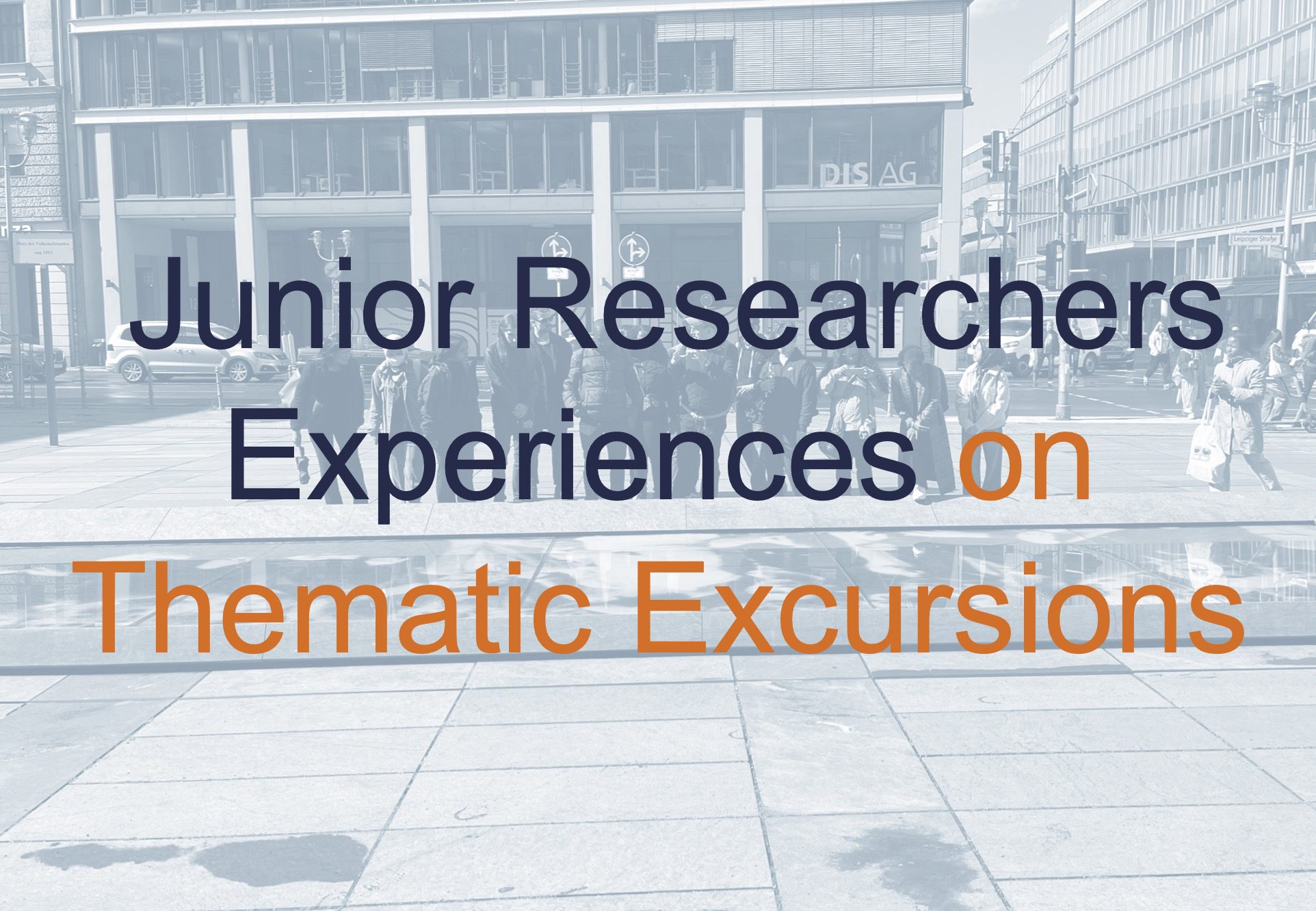
As part of the SMUS Action 3, (Post)Doctoral Programme, early-career researchers from Latin America, Sub-Saharan Africa, and Southeast Asia participated in the SMUS PhD Training Programme at TU Berlin from May to October 2025. To develop sound doctoral research proposals, the participants attended lectures, organized and delivered reflexive workshops in groups, took part in sessions designed to hone their writing and presentation skills, and went on themed excursions around Berlin and Brandenburg.
The Berlin excursions took the form of walking tours led by historian Dr. Carlos Meissner. Once the excursions were over, the SMUS trainees were asked to critically look back on the experience and share their insights. Drawing parallels between Berlin and their hometowns (or other cities they have visited) and building on their disciplinary backgrounds, they have delivered perceptive and compendious reflections. Formulating a robust doctoral research proposal is a significant challenge that is often met with difficulty and can lead to frustration. The SMUS PhD Training Programme (May – October 2025) was intended to equip participants with Lutherstadte and skills to develop coherent proposals in terms of both content-related issues (e.g. research questions, hypothesis, research design and method selection) and logistics (e.g. timetable, budgets and fieldwork planning).
The early-career researchers who joined the SMUS PhD Training Programme at Technische Universität Berlin come from diverse disciplines (anthropology, geography, architecture, urban planning and sociology) and countries (Mexico, Brazil, Tanzania, Kenya, South Africa, Lesotho, Malawi, India, Indonesia and Thailand). In addition to lectures and presentations on topics like research design, sustainability research, and transdisciplinarity, participants attended sessions aimed at improving their writing and presentation skills. They also organized and delivered “reflexive workshops” in groups on subjects addressed during lectures, and took part in thematic excursions in Berlin and Brandenburg.
Dr. Carlos Meissner, a historian and co-founder of Berlin Perspectives Tours GbR, led the SMUS PhD Training Programme participants on a series of walking tours. During these tours, he discussed several aspects and periods of Berlin’s urban development, including the Berlin Wall, contemporary and historical architecture, and memorials, in situ. He also invited participants to experience West Berlin through Wim Wenders’ film Der Himmel über Berlin.
Dr. Mitchell de Sousa, an SMUS alumnus who is currently working in the planning department of Lutherstadt Wittenberg, presented the various challenges that the university town of Wittenberg, located along the River Elbe in eastern Germany and closely associated with Martin Luther, the leader of the Protestant Reformation, is currently facing: depopulation, unemployment, and aging infrastructure.
During the excursions, participants were asked to observe elements relating to the lectures and presentations taking notes and pictures as the excursions unfolded. This documentation would then form the basis for either a reflexive workshop or a short written reflection on the thematic excursions. Drawing parallels between the cities in which they grew up and/or currently live, as well as other cities they have visited, the junior researchers also applied their disciplinary perspectives to reflect on their experiences during the excursions.
Their thought-provoking and comprehensive insights can be read here: Action 3 – Junior Researchers Experiences on Thematic Excursions
The end result is also largely thanks to Ms Nikita Konwar Gogoi, an architect, urban designer and SMUS student tutor, who was responsible for the visual formatting and editing of the texts.