Phase I (2020-2024)
Our archives contain the results and main inputs from Phase I (2020–2024). They are organised into the four preliminary actions. Each one directs you to the relevant action archive.







Our archives contain the results and main inputs from Phase I (2020–2024). They are organised into the four preliminary actions. Each one directs you to the relevant action archive.
During this phase , 4 SMUS partner institutions, the Research Committee on Logic and Methodology in Sociology (RC33) of the International Sociology Association (ISA), and the Research Network Quantitative Methods (RN21) of the European Sociology Association (ESA) contributed to the center’s goal of establishing a global platform for discourse on social science methodology that integrated scholars from the Global North and the Global South. This was done by co-hosting four highly successful international and interdisciplinary conferences on Spatial Methods for Urban Sustainability in Gaborone-Botswana (online, 2021), São Paulo-Brazil (online, 2022), Roorkee-India (2023), and Bangkok-Thailand (2024).
The SMUS Conferences brought together nearly 2,000 methodologists from around the world to explore the various targets of SDG 11 through qualitative or quantitative methodological problems via paper presentations, advanced methodological courses, PhD training days, and keynote addresses.
Research Methodological skills are often abstract, and many scholars find it difficult to put them into action when it comes to their own research topic.
In several disciplines, this challenge is often tackled by designing and conducting a combined teaching-research course.
Under SMUS Action 2, scholars from the partner network were given the opportunity to further their social science methodological teaching and research skills in specific local contexts by suggesting a substantial research question and a methodology they wished to apply in a teaching research course.
The center put out calls to the SMUS network for combined teaching-research courses that drew on the targets covered in SDG#11, and a special emphasis was placed on encouraging South-South teaching tandems
Action 3 revolved around the reflection on methods and the development of methodological skills, aiming at establishing sustainable research connections. Network members were thus encouraged to write doctoral dissertations and post-doctoral research grant proposals. To give way to a long-term sustainable basis for autonomous investigation, the central goal was advancing competencies in the teaching and research staff at partner universities.
Researchers at different academic career stages examined an array of social challenges traversing different topics (heritage, water management, children’s mobility, planning systems, among others) unfolding in the various world regions. In so doing, doctoral and postdoctoral researchers alike turned methodological skills into practice, by developing and mapping frameworks for cross-cultural and socioeconomic perspectives. In addition, spatial research methods and approaches were used and reflected upon. Since the threefold procedure – PhD Training Programme, PhD and Post-Doc Scholarships – was adequate, it is continued in Phase II.
Action 4’s Practical-Empirical Implementation Projects (PEIPs) were meant to put methods into practice. By engaging locally-based and engaged in development cooperation extramural actors (public servants, practitioners or NGOs/CBOs members), the PEIPs sought to re-assess SDG #11’s targets and thus develop alternative, topical and innovative policies as well as design proposals. To this end, participants were presented with a combination of methods from social and design disciplines in the form of a toolkit.
Each PEIP then used the toolkit to explore phenomena connected to various urban sustainability challenges. While certain aspects proved successful (e.g. furthering a ‘methodological dialogue’ between researchers and practitioners), difficulties in breaking through long-standing academic stringencies were faced too (in particular, the issue of legitimisation about the ‘proper’ use of research methods and tools). Consequently, testing method combinations in institutional practical domains achieved limited influence in the policymaking arena. In Phase II, this avenue will be further pursued.
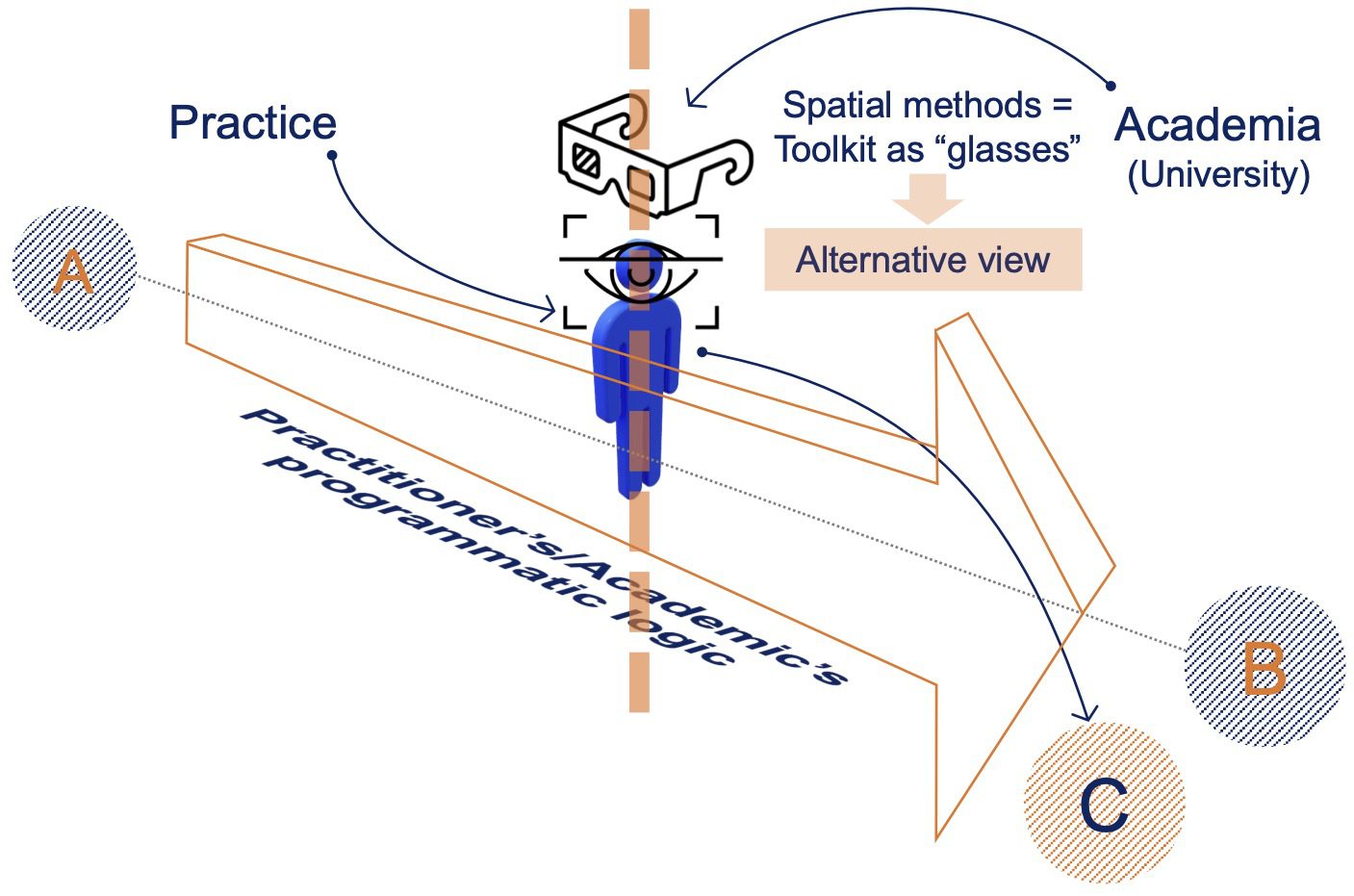
Figure 1: An invitation to (transdisciplinary) teams of practitioners and academics: An alternative view of professional-practical issues via the spatial-method “glasses” (SMUS Action 4 Team)