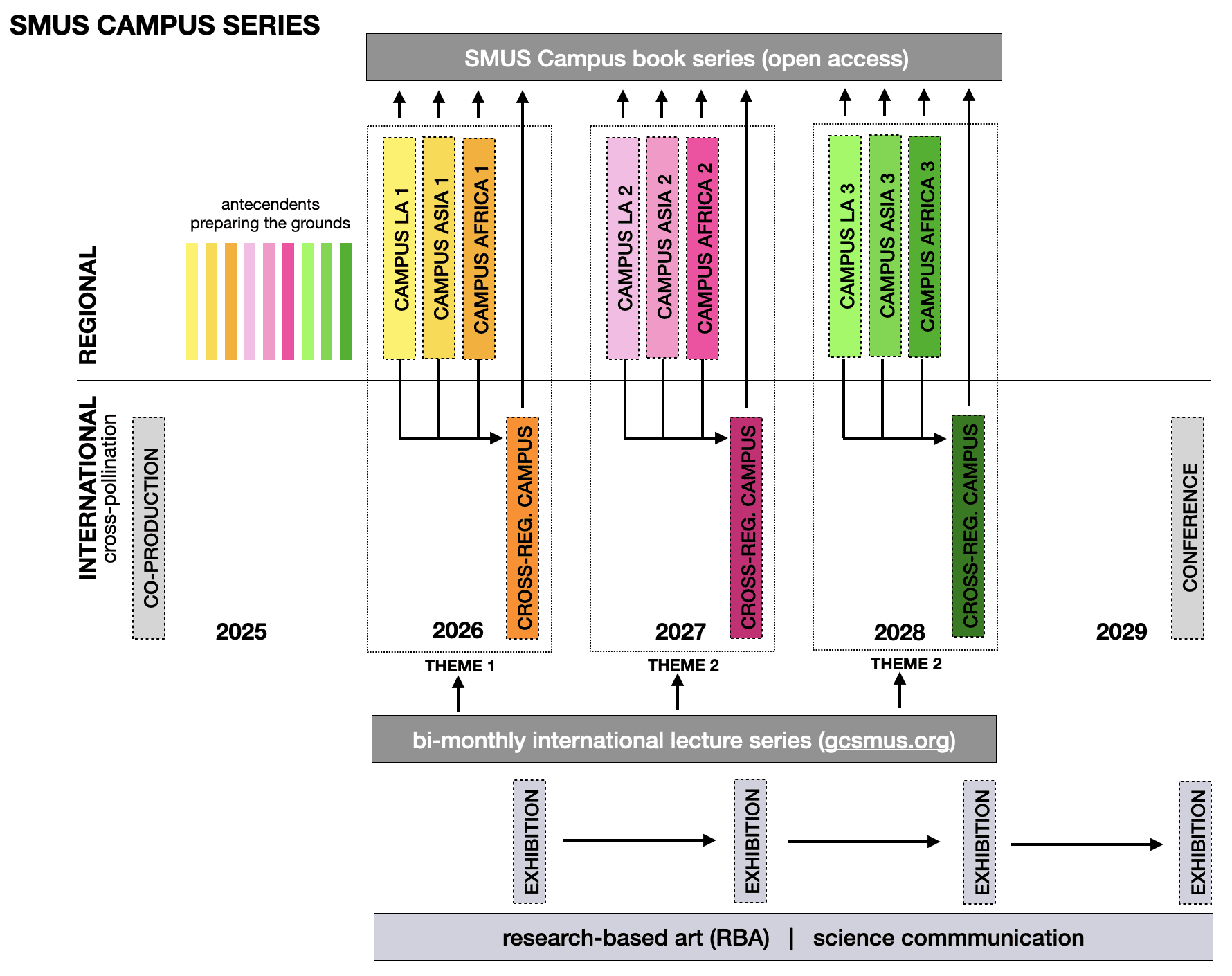






The SMUS Campus Series stimulates scientific excellence clusters in Latin America, East and Southern Africa, and South and Southeast Asia. Nine Regional Campuses across these three world regions explore wicked urban problems (WUP) and look at how they manifest and entangle themselves in each region’s urban spaces. Ultimately aimed at developing region-specific recommendations for action, the focus lies on developing tactics and strategies for WUP through practice-led, transdisciplinary, and spatial “research and teaching”. A crosscutting international layer ensures cross-pollination via Cross-regional Campuses, an international lecture series, and regular online exchanges. Additionally, a research-based art (RBA) layer and science communication layer will enrich the campuses.
The process runs as follows: after “preparing the grounds” in the nine core partner universities (2025), three Regional Campuses run in parallel each year (April-May 2026-2028), with the core partner universities alternating hosting roles. In the first stage, each Scientific Lead integrates the selected theme into a Master Class, after which a small delegation from each university travels to the regional host university, where they are joined by other regional experts. At the end of each year, a Cross-regional Campus brings the discussions on an international level. Each SMUS (Cross-)Regional Campus produces one volume of the open access SMUS Campus book series, which will be published by Berlin University Publishing.